
Looking for an ADHD-friendly homeschool curriculum that actually works? Here are the best curriculum options by learning style, plus tips to choose, adapt, and build a calmer homeschool routine.
Why “ADHD-friendly” matters in homeschooling
When you homeschool a child with ADHD, the curriculum isn’t just “what they learn.” It’s also how smoothly the day runs, how often you battle resistance, and how confident your child feels by lunch.
Many kids with ADHD do best with:
- Short lessons that feel doable
- Clear steps (so they know exactly what to do next)
- Variety (to avoid boredom)
- Built-in movement, hands-on learning, or visual supports
- Flexible pacing (because some days are fast and some are not)
The good news: you don’t need a perfect, expensive program. You need a curriculum that matches your child’s brain and your family’s real life.
What to look for in an ADHD-friendly homeschool curriculum
Before we get into specific curriculum options, use this quick checklist. The best ADHD-friendly homeschool curriculum usually has at least 5–6 of these:

1) Short chunks
Lessons that can be finished in 10–20 minutes (or broken into parts) reduce overwhelm.
2) Clear structure
A simple daily plan, checkboxes, scripted prompts, or step-by-step instructions help kids who struggle with executive function.
3) Multi-sensory learning
Reading + seeing + doing beats “read and answer questions” for many ADHD learners.
4) Low writing load (or writing supports)
ADHD kids often have strong ideas but slow output. Look for programs that allow oral answers, dictation, or incremental writing.
5) Flexible pacing
Self-paced or mastery-based is often a better fit than rigid daily schedules.
6) Built-in review
Spiral review (practice over time) helps retention without long, painful study sessions.
7) Motivation-friendly design
Game-like practice, immediate feedback, interesting topics, and choice keep engagement up.
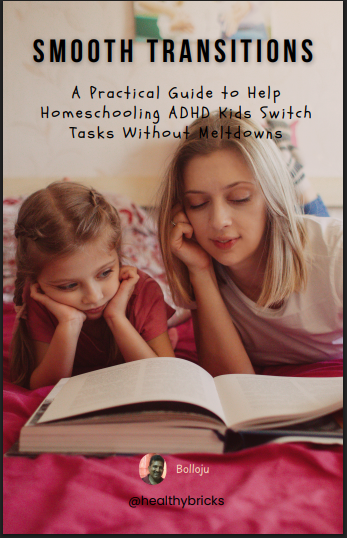
ADHD Daily Routine Check List FREE DOWNLOAD
The best ADHD-friendly homeschool curriculum options by styleD
1) ADHD-friendly online homeschool curriculum (self-paced)
If your child likes screens and thrives with instant feedback, online platforms can be a strong match.
Best for: independent learners, kids who enjoy gamified practice, parents who need support managing multiple kids
Why it helps ADHD: quick rewards, shorter tasks, built-in tracking, less parent instruction time
What to look for:
- Short lessons (not long video lectures)
- Progress bars, goals, and immediate feedback
- “Stop and save” ability so you can do work in sprints
Tip: Keep screen-based work in a specific time block (example: 20 minutes math, 10 minutes break, 15 minutes language). ADHD kids often do better when screens are contained, not spread all day.
2) ADHD-friendly homeschool curriculum that’s open-and-go
Some days you don’t want to plan. You want to open the book and start.
Best for: parents who want structure without building everything from scratch
Why it helps ADHD: fewer decisions, predictable routine, less daily friction
What to look for:
- A clear daily plan page
- Minimal copying
- Short assignments with visible “finish lines”
Tip: Even with open-and-go programs, you can make it more ADHD-friendly by shortening the workload. Doing 60–70% of a lesson consistently beats struggling through 100% and burning out.
3) ADHD-friendly hands-on homeschool curriculum
Hands-on learning is not “extra.” For many ADHD kids, it’s the path to real understanding.
Best for: kids who hate worksheets, wiggle constantly, or learn best by touching and building
Why it helps ADHD: movement increases attention, doing creates memory, and boredom drops fast
What counts as hands-on:
- Experiments, models, games, manipulatives
- Projects, crafts, cooking, building, nature walks
- Math with blocks or tiles, spelling with letter tiles, history with timelines
Tip: Hands-on doesn’t mean messy chaos. Store supplies in a small “learning bin” so you can do a quick activity without turning the house upside down.
4) ADHD-friendly unit studies (interest-led learning)
Unit studies let you build learning around a theme your child cares about (space, animals, trains, weather, Minecraft, sports, etc.).
Best for: kids who focus deeply on interests (hyperfocus), kids who resist traditional work
Why it helps ADHD: interest is fuel, and unit studies reduce subject-switching
How to do unit studies well:
- Keep a simple spine (one main resource like a book, workbook, or video series)
- Add 1–2 extras only (a project + a writing option)
- Use a weekly plan, not a daily rigid schedule
Tip: Include “output choices.” Let your child show learning through a poster, oral summary, comic strip, mini-presentation, short paragraph, or photo journal.
5) ADHD-friendly homeschool curriculum for language arts
Language arts can be the toughest area for ADHD families because it can involve sustained attention, handwriting, and multi-step thinking.
Best for: kids who avoid writing, struggle with spelling, or melt down during reading
Why it helps ADHD: strong programs break skills into tiny pieces and reduce cognitive load
Look for language arts that includes:
- Phonics and decoding support if needed
- Explicit instruction (not “figure it out”)
- Writing scaffolds: sentence starters, graphic organizers, modeling
- Dictation options or speech-to-text compatibility
Make writing ADHD-friendly fast:
- Use oral narration first, then write 1–3 sentences
- Let your child type earlier than you think
- Try speech-to-text for drafts
- Focus on one writing skill at a time (not handwriting + spelling + grammar + ideas all in one sitting)
6) ADHD-friendly homeschool math curriculum
Math can go two ways with ADHD: either it clicks fast or it becomes a daily fight.
Best for: kids who rush and make careless errors, kids who get stuck and shut down
Why it helps ADHD: good math programs give structure, visuals, and lots of short practice
What to look for:
- Visual explanations
- Step-by-step examples
- Built-in review
- Short practice sets
- Manipulatives or interactive practice
Tip: If your child understands the concept but hates worksheets, do fewer problems with higher focus. For example: “Pick 8 problems. Do them slow. Check each one.”
7) ADHD-friendly reading and literature approaches
Not every child needs a heavy literature program. Some ADHD kids do better with lighter, consistent reading routines.
Best for: kids who struggle to sit still for long reading sessions
Why it helps ADHD: consistent short reading builds stamina without exhaustion
Try this approach:
- 10 minutes read-aloud (you read)
- 10 minutes independent reading (they read)
- 3-minute chat: “Tell me the best part. Who is the main character? What changed?”
Tip: Audiobooks count. Pair audiobook + print book when possible to increase comprehension and reduce fatigue.
How to choose the right ADHD-friendly homeschool curriculum (without overthinking)
Here’s a simple way to pick curriculum options that work.
Step 1: Decide your “non-negotiables”
Choose 2–3 things you must have. Examples:
- Open-and-go
- Short lessons
- Minimal writing
- Self-paced
- Hands-on activities
Step 2: Match curriculum to your child’s learning profile
Ask:
- Do they learn best visually, by listening, or by doing?
- Do they need structure or freedom?
- Do they handle independent work, or need you beside them?
Step 3: Start small and build
You don’t need to buy everything at once. Start with:
- One solid math plan
- One language arts plan
- A flexible science or social studies plan (unit studies work great here)
Step 4: Plan for “low-focus days”
Every ADHD homeschool needs a backup plan. Create a simple low-focus routine:
- 10 min reading (audiobook counts)
- 15 min math game or short practice
- 20 min hands-on science/video + discussion
- One life skill (cooking, cleaning, sorting, budgeting, art)
This keeps consistency without forcing heavy academics every day.
How to make any homeschool curriculum more ADHD-friendly
Even if your current curriculum isn’t perfect, these adjustments can change everything:
- Use a visual checklist (3–6 tasks max)
- Set timers for work sprints (10–20 minutes)
- Offer movement breaks (jumping jacks, stretching, wall push-ups)
- Cut the workload but keep the routine
- Use reward loops (finish line + small reward)
- Switch formats: read aloud, use a whiteboard, do oral answers
- Create a “start routine”: pencil ready, water, one clear instruction
Consistency + smaller steps usually beat “better curriculum.”
FAQ: ADHD-friendly homeschool curriculum options
1) What is the best homeschool curriculum for ADHD?
The best homeschool curriculum for ADHD is one that offers short lessons, clear structure, flexible pacing, and multi-sensory learning. The “best” option depends on whether your child learns best visually, hands-on, or through self-paced online work.
2) Is online homeschool curriculum good for ADHD kids?
It can be, especially if lessons are short and interactive. Many ADHD learners benefit from immediate feedback and clear progress tracking. Just keep screen blocks limited and build in movement breaks.
3) How much school time does an ADHD homeschooler need?
Many ADHD kids do better with less total seat time and more quality focus. Depending on age, 1.5–3.5 hours of structured learning (broken into blocks) can be plenty, plus reading and hands-on projects.
4) What if my child refuses the curriculum I bought?
That’s common. Try reducing the workload, adding choices (write, type, or speak), and using shorter work sprints. If it’s still a daily battle after a few weeks of adjustments, it’s okay to switch.
5) Can unit studies work for ADHD homeschooling?
Yes. Unit studies often work very well because interest drives focus and they reduce constant subject switching. Keep it simple: one main resource + one project + one output choice.
Conclusion: The “best” ADHD-friendly homeschool curriculum is the one your child can actually do
When you’re choosing ADHD-friendly homeschool curriculum options, don’t chase perfection. Chase consistency. Look for programs that make starting easier, keep lessons short, reduce writing overload, and allow flexibility.
If you want a simple starting point, build your homeschool around:
- A structured, clear math plan
- A supportive language arts plan with scaffolding and low-pressure writing
- Interest-led science/social studies (unit studies or hands-on learning)
And remember: you can make almost any curriculum more ADHD-friendly by shortening lessons, adding movement, and giving your child clear, doable steps.