
Worried your child is struggling in school? Learn the early signs of ADHD in children, dyslexia, dysgraphia, and other learning disorders in kids. Discover causes, expert-backed solutions, and when to seek professional help.
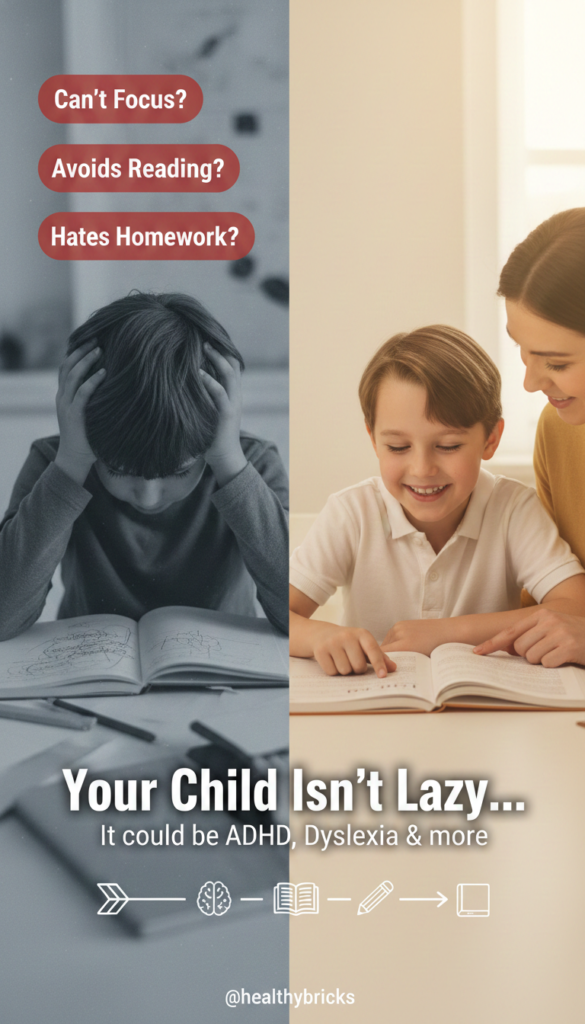
It’s Not Laziness—It’s Something Deeper
Many parents quietly worry when their child struggles with reading, writing, or focus. The first instinct is often to assume a lack of effort. But here’s the truth—not all learning disorders in kids are about discipline or motivation.
Some children are dealing with underlying learning and neurodevelopmental conditions that require professional support. Ignoring these signs can lead to frustration, low confidence, and long-term academic challenges.
This guide will help you understand what’s really going on—and what to do next.
What Are Learning & Neurodevelopmental Disorders in Kids?
Learning and neurodevelopmental disorders are conditions that affect how a child processes, understands, or responds to information. These are not linked to intelligence. In fact, many children with these challenges are highly capable but struggle in traditional school settings.
Common examples include:
- Dyslexia
- Dyscalculia
- Dysgraphia
- Attention-Deficit/Hyperactivity Disorder
- Autism Spectrum Disorder
These conditions affect different areas of learning, from reading and writing to attention and social interaction.
Signs of Learning Disorders in Kids (Early Warning Signals)
Recognizing the signs early can make a huge difference. Here are some common red flags parents often miss:
🔍 Academic Signs
- Difficulty reading simple words or sentences
- Trouble understanding basic math concepts
- Poor handwriting or avoiding writing tasks
- Frequent spelling mistakes despite practice
🧠 Behavioral Signs
- Short attention span or easily distracted
- Avoidance of homework or schoolwork
- Appearing “lazy” or uninterested
- Taking much longer than peers to complete tasks
😔 Emotional Signs
- Frustration during study time
- Low confidence or self-esteem
- Anxiety around school or exams
- Saying things like “I’m not smart”
These signs often overlap, making it harder for parents to identify the exact issue without professional help.🔎 Common Types of Learning Disorders Explained
📖 Dyslexia (Reading Disorder)
Children with Dyslexia struggle with reading, spelling, and word recognition. They may mix up letters or avoid reading altogether.
🔢 Dyscalculia (Math Disorder)
Dyscalculia affects a child’s ability to understand numbers, patterns, and calculations. Even basic math can feel overwhelming.
✍️ Dysgraphia (Writing Disorder)
Kids with Dysgraphia may have messy handwriting and difficulty organizing thoughts on paper.
⚡ ADHD in Children (Attention Issues)
Attention-Deficit/Hyperactivity Disorder impacts focus, impulse control, and activity levels. It’s often misunderstood as “bad behavior.”
🧩 Autism Spectrum Disorder (ASD)
Autism Spectrum Disorder affects communication, behavior, and social skills. Symptoms vary widely from child to child.
🤯 Why Smart Kids Still Struggle in School
One of the biggest misconceptions is that struggling kids are less intelligent. That’s not true.
Many children with learning disorders:
- Have average or above-average intelligence
- Think creatively or differently
- Excel in non-academic areas
The issue lies in how they process information, not their ability to learn.
Traditional classrooms are designed for a one-size-fits-all approach. Children who learn differently often fall through the cracks.
⚠️ Why You Shouldn’t Ignore These Signs
Delaying support can lead to:
- Academic failure
- Emotional distress
- Behavioral issues
- Loss of self-confidence
Over time, children may start believing they are “not good enough,” which can affect their mental health.
Early intervention can completely change this trajectory.👩⚕️ When to Seek Professional Help for Learning Disorders in kids
You should consider expert evaluation if:
- Your child consistently struggles despite effort
- Teachers report ongoing concerns
- Homework leads to frequent meltdowns
- Progress is significantly slower than peers
Specialists who can help include:
- Educational psychologists
- Developmental pediatricians
- Special educators
- Child psychologists
A proper assessment can provide clarity and a structured plan for support.🛠️ How Specialists Help Children with Learning Disorders
Professional support is not just about diagnosis—it’s about building a path forward.
Here’s what specialists typically do:
📊 Assessment & Diagnosis
They use standardized tools to identify specific learning challenges.
🎯 Personalized Learning Plans
Customized strategies based on your child’s needs.
🧠 Skill Development
Focused interventions to improve reading, writing, or attention.
💬 Emotional Support
Helping children build confidence and reduce frustration.🏠 What Parents Can Do (Alongside Professional Help)
While specialist support is essential, parents still play a key role.
- Create a calm, distraction-free study space
- Break tasks into smaller steps
- Celebrate effort, not just results
- Avoid labeling your child as lazy or careless
- Communicate openly with teachers
The goal is to support—not pressure—your child.❓ FAQs About Learning Disorders in Kids
1. Can learning disorders be cured?
Learning disorders cannot be “cured,” but they can be effectively managed with the right support and strategies.
2. At what age can learning disorders be diagnosed?
Some signs appear as early as preschool, but formal diagnosis usually happens around ages 6–8.
3. Is ADHD in children a learning disorder?
Attention-Deficit/Hyperactivity Disorder is not a learning disorder but often coexists with them and affects learning.
4. Can a child outgrow these issues?
Children don’t outgrow them, but they can learn to manage them successfully with proper guidance.
5. Are these conditions caused by parenting?
No. These are neurological conditions and not a result of parenting style.
🧾 Conclusion: Look Beyond the Labels
If your child is struggling in school, pause before assuming the worst. What looks like laziness may actually be a hidden learning challenge.
With early identification, the right support, and a bit of patience, children with learning disorders can thrive—not just academically, but in life.
The key is simple: observe, understand, and act early.
