
Living with ADHD is often misunderstood. From the outside, it can look like distraction, inconsistency, or lack of effort.
From the inside, it feels very different. It feels like caring deeply, trying constantly, and still struggling in ways that are hard to explain.
For adults, ADHD does not disappear with age. In many cases, it becomes more noticeable as responsibilities increase.
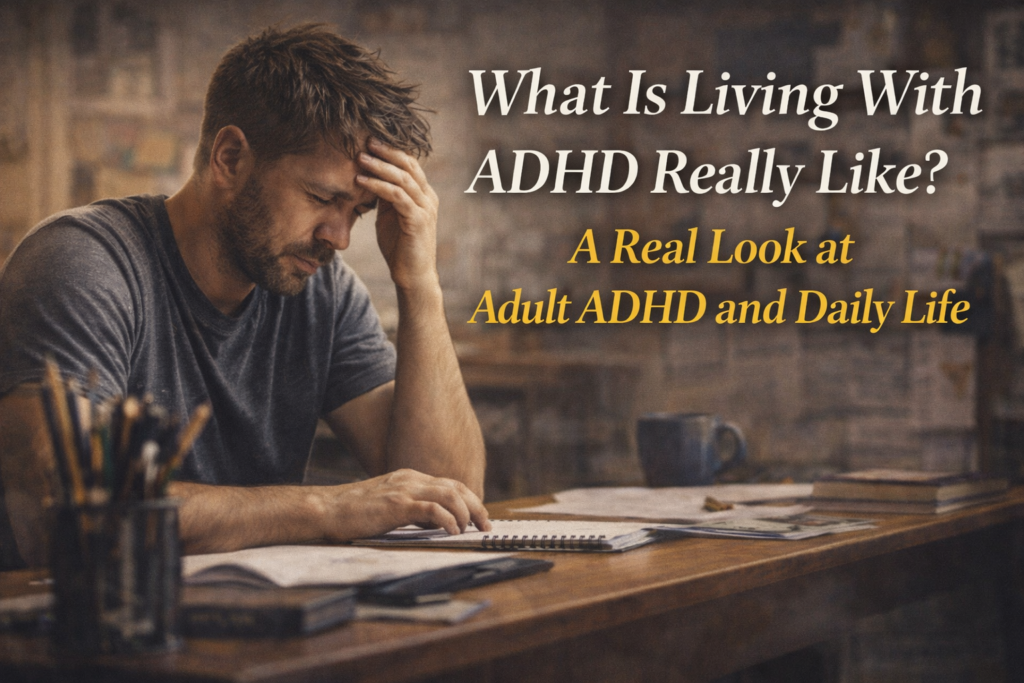
Work demands, relationships, parenting, and daily life require skills that ADHD directly affects.
This article explores what living with ADHD is really like, how it shows up in adulthood, and why many ADHD behaviors are misjudged.
If you have ADHD or live with someone who does, this guide will help you understand it better.
What Is Living With ADHD Like?
Living with ADHD often feels like having a brain that refuses to cooperate on demand.
You may know exactly what needs to be done, yet struggle to start. Tasks that seem simple to others can feel mentally exhausting. Meanwhile, activities that spark interest can pull your attention so deeply that time disappears.
Common experiences of living with ADHD include:
- Difficulty starting tasks, even important ones
- Forgetting things you genuinely care about
- Feeling mentally overwhelmed by small responsibilities
- Struggling with time awareness
- Feeling judged for behaviors you cannot fully control
ADHD is not just about attention. It affects motivation, emotional regulation, working memory, and energy levels. That is why daily life with ADHD can feel harder than it looks.

Visual Weekly Subject Planners for ADHD Students
What Is It Really Like to Live With ADHD as an Adult?
Adult ADHD often comes with years of self-doubt.
Many adults with ADHD grew up being told they were lazy, careless, or not trying hard enough. Over time, this creates shame and anxiety around performance and relationships.
Living with ADHD as an adult can feel like:
- Constantly apologizing for mistakes
- Overthinking conversations and social interactions
- Burning out from masking symptoms
- Feeling behind in life compared to others
- Struggling with consistency, not ability
Despite these challenges, many adults with ADHD are creative, empathetic, and resourceful.
The difficulty is that these strengths do not always show up when structure and expectations work against the ADHD brain.
Can Someone With ADHD Have a Normal Life?
Yes, someone living with ADHD can absolutely have a full and meaningful life. However, that life may look different from traditional expectations.
A “normal” life with ADHD often includes:
- Flexible routines instead of rigid schedules
- External supports like reminders and visual tools
- Work environments that allow autonomy
- Relationships based on understanding, not criticism
- Rest without constant guilt
The problem is not ADHD itself. The problem is trying to force an ADHD brain to function like a non-ADHD brain.
When people build systems that match how their brain works, daily life becomes more manageable.

How to Explain ADHD in Adults?
Explaining ADHD in adults can be challenging, especially when people assume it is just a childhood condition.
A simple explanation is this:
Adult ADHD is not about lacking knowledge or effort. It is about difficulty regulating attention, motivation, emotions, and time.
Adults with ADHD usually:
- Know what they need to do
- Want to do it
- Feel stressed about not doing it
- Still struggle to follow through
This gap between intention and action is one of the most misunderstood aspects of ADHD. It is neurological, not personal.
What Are Common ADHD Behaviors in Adults That Seem Disrespectful?
Many ADHD behaviors are often misinterpreted as rude or careless when they are not intentional.
Common ADHD behaviors in adults include:
- Interrupting conversations
- Forgetting plans or appointments
- Being late despite trying to be on time
- Appearing distracted when listening
- Struggling to complete tasks consistently
These behaviors are linked to impulsivity, working memory challenges, and time blindness.
They are not signs of disrespect or lack of care. In fact, many adults with ADHD feel deep guilt and frustration over these patterns.
Understanding this distinction can dramatically improve communication and relationships.
What Does High Functioning ADHD Look Like?
High functioning ADHD is not a medical diagnosis. It is a term often used to describe people who appear successful while privately struggling.
High functioning ADHD may look like:
- Holding a job but feeling constantly overwhelmed
- Meeting deadlines through last-minute panic
- Appearing organized while feeling mentally exhausted
- Masking symptoms in public
- Burning out in private
Many adults with high functioning ADHD are diagnosed later in life because their coping strategies worked until demands increased.
Success does not mean the struggle is absent. It often means the struggle is hidden.
What Is the 20 Minute Rule for ADHD?
The 20 minute rule for ADHD is a simple strategy designed to reduce task paralysis.
The rule is straightforward:
Commit to working on a task for just 20 minutes, then reassess.
Why the 20 minute rule helps people living with ADHD:
- Starting feels less overwhelming
- Pressure and perfectionism decrease
- Momentum often builds naturally
- Progress feels more achievable
For some people, even shorter time blocks like 5 or 10 minutes work better. The goal is not productivity perfection. The goal is reducing resistance to starting.
Emotional Challenges of Living With ADHD
Living with ADHD affects emotions just as much as attention.
Many adults experience:
- Intense emotional reactions
- Sensitivity to criticism or rejection
- Difficulty regulating frustration or anger
- Emotional exhaustion from self-monitoring
- Anxiety from repeated setbacks
These emotional challenges are neurological, not personality flaws. Learning emotional regulation tools and practicing self-compassion can significantly improve quality of life.
ADHD at Work and in Daily Life
Work environments often highlight ADHD challenges, especially those with rigid schedules and unclear expectations.
Common workplace struggles include:
- Long meetings with little engagement
- Vague instructions
- Heavy multitasking
- Unrealistic deadlines
- Lack of flexibility
Many adults with ADHD thrive in roles that offer creativity, problem-solving, or autonomy.
Others succeed by using external systems such as planners, timers, and accountability tools.
ADHD does not limit potential. It changes how support and structure are needed.
Frequently Asked Questions About Living With ADHD
What is living with ADHD really like?
Living with ADHD often feels like trying hard but still struggling with focus, time management, emotional regulation, and follow-through.
It is not a lack of effort or intelligence, but a difference in how the brain manages attention and motivation.
Can someone with ADHD have a normal life?
Yes. People with ADHD can live full and meaningful lives. A normal life with ADHD may look different and often includes flexible routines, supportive tools, and environments designed to reduce overwhelm.
How do you explain ADHD in adults?
Adult ADHD is best explained as difficulty regulating attention, emotions, motivation, and time. Adults with ADHD usually know what needs to be done but struggle to start and sustain tasks consistently.
What ADHD behaviors in adults are often mistaken as disrespectful?
Behaviors like interrupting, forgetting plans, being late, or appearing distracted are commonly linked to ADHD symptoms such as impulsivity and time blindness. These behaviors are usually unintentional.
What does high functioning ADHD look like?
High functioning ADHD describes people who appear successful outwardly while privately struggling with burnout, anxiety, procrastination, and emotional exhaustion from masking symptoms.
What is the 20 minute rule for ADHD?
The 20 minute rule involves committing to a task for just 20 minutes before deciding whether to continue. This reduces task paralysis and helps build momentum for people with ADHD.
Conclusion: Understanding Life With ADHD
Living with ADHD is not about trying harder or fixing yourself. It is about understanding how your brain works and creating systems that support it.
When ADHD is viewed with empathy instead of judgment, daily life becomes more manageable. Progress comes from awareness, flexibility, and self-compassion, not perfection.
If you are living with ADHD, you are not broken. You are adapting in a world that was not designed for how your brain works.
