
Learn 5 practical ways to prevent ADHD homeschool meltdowns before they happen. Discover emotional regulation strategies, routines, sensory supports, and simple ADHD homeschooling tips for calmer learning days.
Homeschooling a child with ADHD can feel unpredictable. Some days run smoothly, while others suddenly turn into tears, yelling, refusal, or complete shutdowns. Many parents assume these moments appear without warning, but most ADHD homeschool meltdowns begin long before emotions explode.
The good news is this: many emotional outbursts can be reduced before they start.
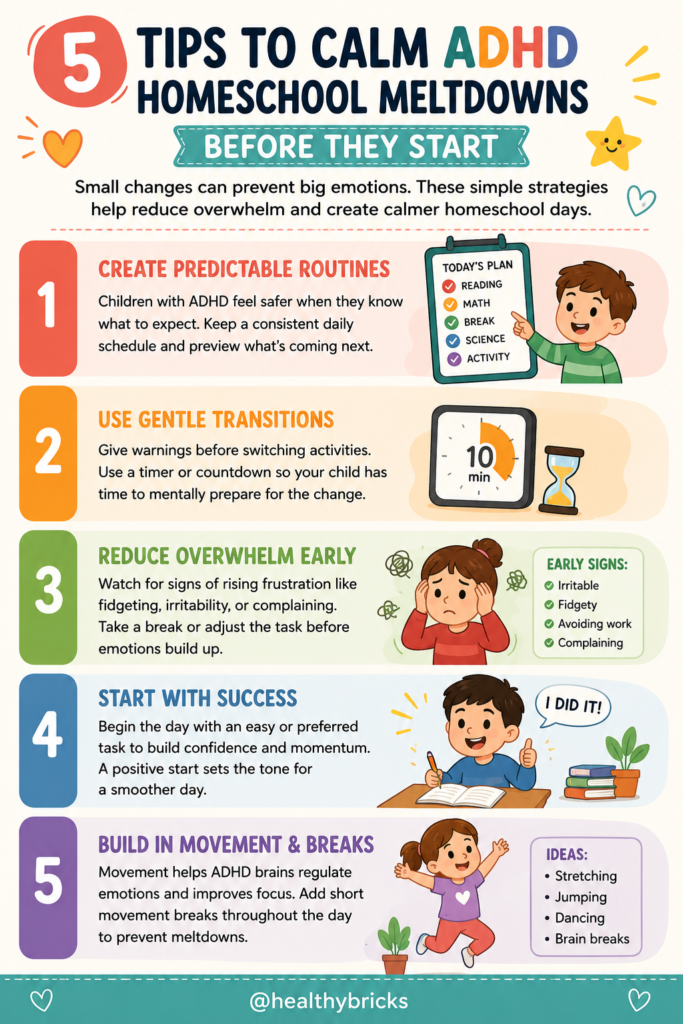
Children with ADHD often experience challenges with emotional regulation, transitions, working memory, attention, and sensory processing. When these difficulties pile up during homeschool lessons, frustration builds fast. Understanding what triggers overwhelm gives parents a chance to intervene earlier.
CLICK HERE : For FREE Starter Pack On ADHD-Friendly Homeschooling
This guide shares five practical strategies to help prevent ADHD homeschool meltdowns and create calmer learning experiences at home.
Why ADHD Homeschool Meltdowns Happen
Before discussing solutions, it helps to understand why emotional outbursts happen.
Meltdowns are rarely about defiance. They are often signs that the brain has reached overload.
Common causes include:
- Too many transitions
- Difficult academic tasks
- Long learning sessions
- Sensory overload
- Poor sleep or hunger
- Unexpected schedule changes
- Fear of failure
- Executive functioning struggles
Children with ADHD frequently work harder than their peers just to maintain focus. That constant mental effort creates exhaustion much faster than many parents realize.
Tip 1: Create Predictable Routines Without Becoming Rigid
Routine creates safety for ADHD brains.
When children know what happens next, they spend less energy handling uncertainty. Predictable schedules reduce anxiety and improve emotional regulation.
Try creating routines that stay consistent but flexible.
Examples include:
- Morning movement before academics
- Consistent lesson order
- Visual schedules
- Transition warnings
- Predictable break times
Children often resist less when they understand what comes next.
How Flexible Structure Works Better ADHD homeschool meltdowns
Avoid making schedules too strict. ADHD children often struggle when routines become impossible to maintain.
Instead of:
9:00 AM exactly = math
Try:
Morning Block = math sometime between 9:00–10:00
Flexibility reduces pressure.
Tip 2: Reduce Overwhelm Before It Builds
Overwhelm builds quietly.
Parents sometimes notice meltdowns only after emotions explode, but small warning signs usually appear first.
Watch for:
- Increased movement
- Complaining
- Avoidance
- Irritability
- Frequent bathroom trips
- Daydreaming
- Saying “this is too hard”
Signs of Overwhelm and What To Do
| Early Warning Sign | What It Might Mean | Parent Response |
| Fidgeting increases | Mental overload | Add movement break |
| Complaining often | Task feels too hard | Reduce workload |
| Avoiding work | Anxiety or confusion | Break into smaller tasks |
| Emotional reactions | Stress building | Pause lesson |
| Zoning out | Attention fatigue | Switch activities |
Small interventions often prevent larger problems later.
Tip 3: Use Gentle Transitions Instead of Abrupt Changes
Transitions are hard for many ADHD children.
Stopping preferred activities or switching subjects forces the brain to redirect attention quickly. This can trigger frustration.
Try using transition supports:
Give Countdown Warnings
Examples:
- “10 minutes left”
- “5 more minutes”
- “Last problem before break”
Use Visual Timers
Visual timers help children see time passing rather than guessing.
Create Transition Rituals
Simple rituals reduce stress:
- Stretching
- Water breaks
- Music cue
- Movement activity
- Deep breaths
Transition support lowers emotional resistance significantly.
Tip 4: Build Movement and Sensory Breaks Into Learning
ADHD brains often regulate attention through movement.
Expecting long periods of sitting increases frustration and emotional overload.
Movement breaks are not distractions.
They are tools.
Examples include:
- Jumping jacks
- Stretching
- Wall pushes
- Walking outside
- Dance breaks
- Carrying books
- Balance exercises
Sensory Needs Matter Too in ADHD homeschool meltdowns
Sensory overload contributes heavily to ADHD homeschool meltdowns.
Consider:
- Noise-canceling headphones
- Fidgets
- Flexible seating
- Reduced clutter
- Soft lighting
- Quiet workspaces
Small sensory adjustments create major improvements.
Tip 5: Start With Success and Build Momentum
Children are more willing to tackle hard tasks after experiencing success.
Beginning homeschool with difficult subjects often creates resistance early.
Instead:
Start with:
- Easy wins
- Favorite subjects
- Short tasks
- Activities they enjoy
- Hands-on lessons
Success creates confidence.
Confidence reduces emotional overwhelm.
The Power of Momentum
A child who finishes one small task successfully is more likely to attempt the next.
Progress builds motivation.
Motivation reduces resistance.

What To Do When a Meltdown Starts Anyway
Even with preparation, meltdowns still happen.
During emotional overload:
Do:
- Lower demands
- Stay calm
- Reduce talking
- Validate feelings
- Provide space
- Focus on safety
Avoid:
- Long lectures
- Arguing
- Punishment during escalation
- Adding more work
- Taking behavior personally
Regulation comes before learning.
Always.
Building an ADHD-Friendly Homeschool Environment
Your homeschool environment affects emotions more than you may realize.
Try improving:
Physical Environment
- Reduce clutter
- Add comfortable seating
- Organize supplies
Emotional Environment
- Encourage mistakes
- Praise effort
- Reduce perfectionism
Learning Environment
- Short lessons
- Frequent breaks
- Flexible schedules
A calm environment supports a calm nervous system.
Takeaway: Small Changes Prevent Bigger Struggles
Preventing ADHD homeschool meltdowns is not about perfect parenting or perfect routines.
It is about noticing overwhelm early.
Small adjustments like predictable routines, movement breaks, easier transitions, sensory supports, and building confidence can dramatically improve homeschool experiences.
Progress may feel slow.
That is normal.
Children learn emotional regulation over time, and parents do too.
Focus on creating safety first.
Learning usually follows.
Frequently Asked Questions (FAQ)
Can ADHD homeschool meltdowns be completely prevented?
Not always. Emotional outbursts still happen. The goal is reducing frequency, intensity, and recovery time rather than expecting perfection.
How long does it take to see improvements?
Some families notice changes within days. Others need several weeks of consistent practice. Progress depends on your child’s age, needs, and triggers.
Are meltdowns the same as tantrums?
Not usually. ADHD meltdowns often happen because of nervous system overload rather than intentional behavior.
Should I stop lessons during emotional overwhelm?
Often yes. Learning becomes difficult when emotions are too high. Regulation first usually leads to better outcomes later.
What age group works best for these strategies?
These strategies work for younger children, older children, and even teens. You may simply adjust how they are applied.
