
Discover practical, screen-free strategies to stop the “I’m bored” whining without handing over an iPad. Learn simple routines, activities, and parenting tips that encourage creativity and independent play.
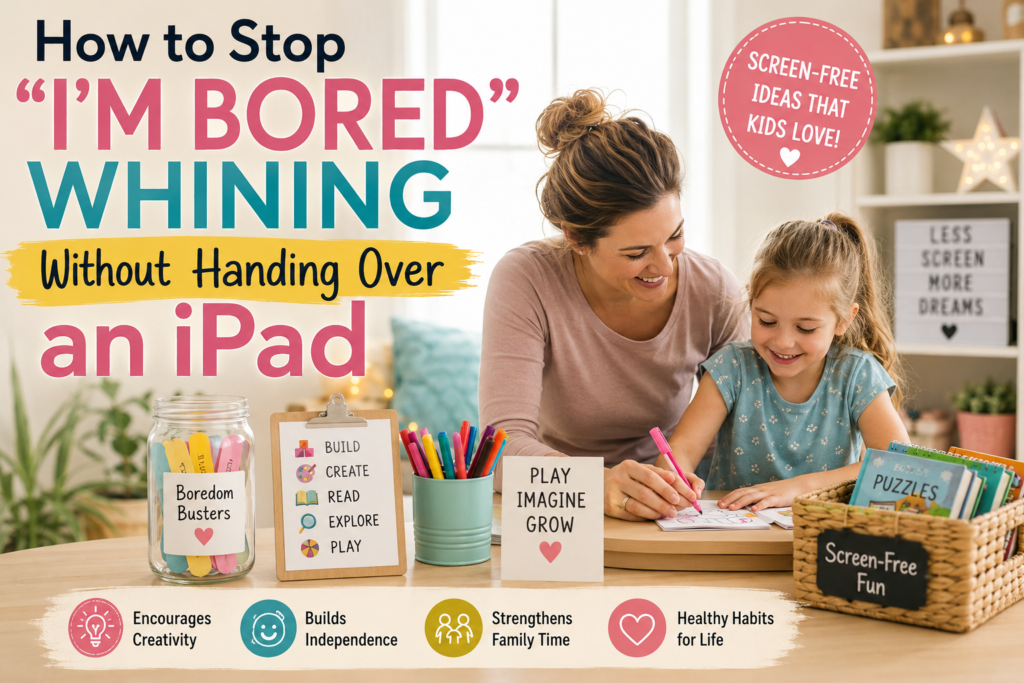
How to Stop the “I’m Bored” Whining Without Handing Over an iPad
If you’ve ever heard, “Mom, I’m bored!” just minutes after breakfast or immediately after turning off the TV, you’re not alone.
Many parents struggle with the same challenge. It often feels easier to hand over an iPad than to argue, negotiate, or brainstorm another activity. While technology has its place, relying on screens every time boredom strikes can make it harder for children to develop creativity, patience, and independent problem-solving skills.
The good news is that boredom isn’t the enemy. In fact, boredom can become an opportunity for imagination and learning when children have the right tools and routines.
In this guide, you’ll learn how to stop “I’m bored” whining without handing over an iPad using simple, practical strategies that work for children of different ages.
Why Kids Say “I’m Bored” So Often
Children today are surrounded by instant entertainment. Videos, games, and apps provide constant stimulation.
When those activities stop, everyday life can suddenly feel slow.
Sometimes “I’m bored” actually means:
- I don’t know what to do.
- I want your attention.
- I need movement.
- I’m tired.
- I want something exciting.
- I don’t want to make my own decision.
Recognizing what your child truly needs helps you respond calmly instead of immediately offering another screen.Children today are surrounded by instant entertainment. Videos, games, and apps provide constant stimulation.
When those activities stop, everyday life can suddenly feel slow.
Sometimes “I’m bored” actually means:
- I don’t know what to do.
- I want your attention.
- I need movement.
- I’m tired.
- I want something exciting.
- I don’t want to make my own decision.
Recognizing what your child truly needs helps you respond calmly instead of immediately offering another screen.
Why Constant Screen Time Doesn’t Solve Boredom
Screens quickly eliminate boredom, but only temporarily.
After hours of fast-paced entertainment, children may struggle to enjoy slower activities like reading, drawing, building, or imaginative play.
Too much recreational screen time may also contribute to:
- Less physical activity
- Reduced creativity
- Frequent arguments when it’s time to stop
- Difficulty transitioning between activities
- Increased dependence on digital entertainment
The goal isn’t to eliminate screens completely. Instead, it’s to help children discover that fun exists beyond a screen.
ALSO READ : 5 Tips to Calm ADHD Homeschool Meltdowns Before They Start
Create a Daily Screen-Free Routine
One of the easiest ways to reduce boredom complaints is by creating predictable routines.
Children often handle transitions better when they know what comes next.
A simple routine might include:
- Morning chores
- Outdoor play
- Reading time
- Creative activity
- Lunch
- Quiet time
- Family games
- Limited screen time
When children know screens aren’t available all day, they begin looking for other ways to stay busy.
Make a Boredom Jar
A boredom jar is one of the simplest screen-free activities for kids.
Write different activity ideas on slips of paper and place them inside a jar.
Examples include:
- Build a blanket fort.
- Draw your dream bedroom.
- Make a paper airplane contest.
- Dance to three songs.
- Read one chapter of a book.
- Create a treasure hunt.
- Build with blocks.
- Paint a picture.
- Practice juggling with socks.
- Write a funny comic strip.
Whenever your child says, “I’m bored,” let them pull one idea instead of asking for an iPad.
Encourage Independent Play
Independent play helps children build confidence and creativity.
Instead of directing every activity, provide open-ended materials like:
- LEGO bricks
- Wooden blocks
- Art supplies
- Dress-up clothes
- Puzzles
- Toy animals
- Magnetic tiles
- Play dough
Avoid interrupting too quickly.
Children often need several minutes before their imagination begins working.
Offer Screen-Free Activities That Match Your Child’s Interests
Not every child enjoys the same hobbies.
Experiment until you discover activities that naturally hold their attention.
Ideas include:
Creative Kids
- Painting
- Clay modeling
- Coloring
- DIY crafts
- Origami
Active Kids
- Backyard obstacle course
- Jump rope
- Bike ride
- Nature walk
- Dance party
Curious Kids
- Science experiments
- Cooking together
- Gardening
- Bird watching
- Building challenges
Quiet Kids
- Reading
- Journaling
- Audiobooks
- Puzzle books
- Sticker activities
Matching activities to personality makes them much more successful.
Use the “First, Then” Strategy
Instead of saying:
“No iPad.”
Try saying:
“First play outside for 30 minutes, then you can earn screen time.”
This simple approach reduces arguments because children know exactly what is expected.
Create a Screen Time Token System
Many families find token systems helpful.
For example:
- Finish homework = 1 token
- Read for 20 minutes = 1 token
- Complete chores = 1 token
- Outdoor play = 1 token
Children exchange tokens for limited screen time.
This teaches responsibility while making screen time feel earned rather than automatic.
Make Boredom a Family Challenge
Children are more likely to participate when parents join occasionally.
Try family challenges like:
- Who builds the tallest tower?
- Family scavenger hunt
- Cook dinner together
- Puzzle race
- Backyard Olympics
- Family art contest
These shared experiences often become favorite memories.
Keep a Screen-Free Activity Basket
Create an easily accessible basket filled with:
- Coloring books
- Puzzle books
- Building blocks
- Card games
- Craft supplies
- Books
- Fidget toys
- Dry-erase activity cards
Rotate items every few weeks to keep them exciting.
Avoid Becoming the Entertainment Director
Parents often feel pressure to solve every complaint.
Instead, respond calmly.
When your child says:
“I’m bored.”
You can reply:
“I believe you’ll think of something fun.”
This encourages problem-solving without dismissing their feelings.
Set Clear Screen Time Expectations
Children benefit from consistent boundaries.
Consider rules such as:
- No screens before breakfast.
- Homework comes first.
- Outdoor play before electronics.
- Family meals are screen-free.
- Devices stay outside bedrooms at night.
Consistency matters more than strictness.
What to Do During School Breaks
Summer and holiday breaks often bring more boredom.
Plan a loose daily rhythm instead of a strict schedule.
Include:
- Reading
- Outdoor time
- Creative projects
- Free play
- Chores
- One educational activity
- Limited recreational screen time
Children thrive when every hour isn’t planned but the day still has structure.
Mistakes Parents Often Make
Avoid these common habits:
- Giving screens immediately after every complaint.
- Creating overly strict screen rules that are impossible to maintain.
- Scheduling every minute of the day.
- Expecting children to entertain themselves instantly.
- Using screens as the only reward.
Balance works better than perfection.
Benefits of Reducing Screen Time
When children spend less time on devices, many families notice improvements such as:
- More imaginative play
- Better communication
- Increased physical activity
- Improved problem-solving skills
- Stronger family relationships
- Greater independence
- Better sleep routines
These changes usually happen gradually with consistency.
Frequently Asked Questions
How much recreational screen time is appropriate for children?
The right amount depends on a child’s age, needs, and family values. Focus on creating a healthy balance between screen use, physical activity, learning, sleep, and face-to-face interaction rather than aiming for a single number.
What should I do if my child refuses every screen-free activity?
Stay calm and avoid immediately offering a device. Give your child time to work through the boredom. Sometimes children need a few minutes before they begin creating their own entertainment.
Is boredom actually good for children?
Yes. Boredom can encourage creativity, independent thinking, problem-solving, and imaginative play when children have opportunities to explore without constant digital stimulation.
Should I eliminate screens completely?
Not necessarily. Technology can be useful for learning, communication, and entertainment. The goal is to create healthy boundaries and ensure screens don’t replace sleep, physical activity, social interaction, or creative play.
What age should children start learning independent play?
Even toddlers can begin developing independent play in short, supervised periods. As children grow older, they can gradually spend more time entertaining themselves with age-appropriate activities.
Conclusion
Hearing “I’m bored” can feel exhausting, especially on busy days. However, boredom doesn’t have to lead directly to an iPad or television.
By creating predictable routines, offering engaging screen-free activities, encouraging independent play, and setting consistent expectations around technology, you can help your child develop confidence, creativity, and resilience.
Remember, you don’t need to eliminate screens entirely. Instead, focus on helping your child discover the joy of building, creating, exploring, reading, and imagining. Those are the moments that often lead to lifelong skills and cherished family memories.
The next time your child says, “I’m bored,” smile, point them toward a new adventure, and let their imagination take the lead.
