
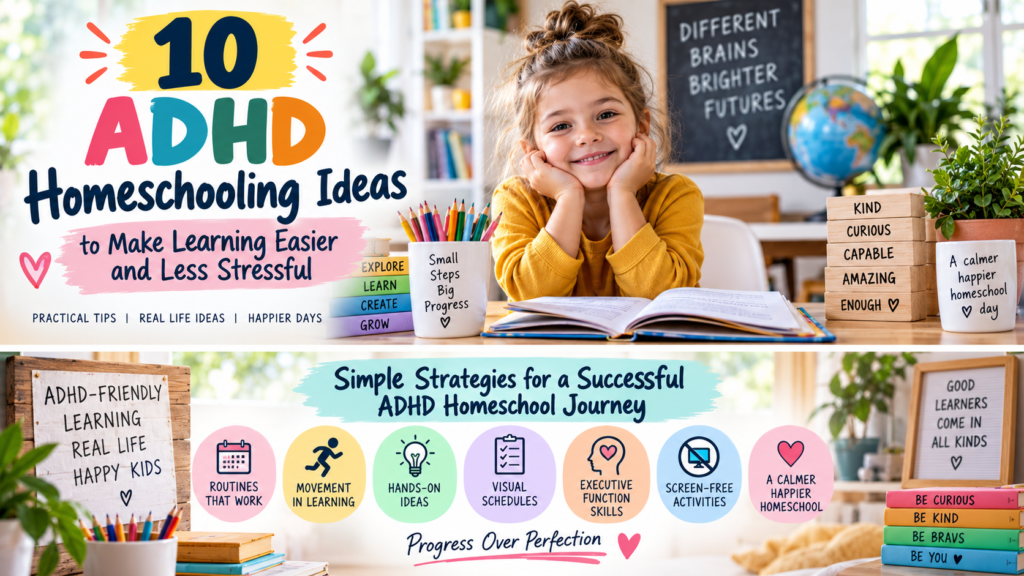
Discover 10 practical ADHD homeschooling ideas, including visual schedules, movement breaks, short lessons, executive function activities, and neuro-divergent-friendly learning strategies for less stressful homeschool days.
Homeschooling can look wonderfully organized on paper.
You have the curriculum ready.
The books are stacked neatly.
The lesson plan is written.
The pencils are sharpened.
Then your child sits down.
Two minutes later, they’re looking out the window.
Five minutes later, they’re asking for a snack.
Ten minutes later, the pencil disappeared.
And somehow, one worksheet has turned into a full morning of frustration.
If this sounds familiar, you’re certainly not alone.
ALSO READ: 12 July Homeschool Ideas for an Engaging and ADHD-Friendly Summer
ADHD homeschooling often requires a different approach to traditional homeschooling. Children with ADHD may struggle with sustained attention, task initiation, organization, working memory, transitions, and managing distractions.
Visual Weekly Planners For ADHD Homeschooling
That doesn’t mean learning has to be difficult.
Sometimes the solution isn’t asking a child to try harder.
It’s changing the way the learning experience is presented.
Shorter lessons, visual schedules, movement, hands-on activities, predictable routines, and interest-based learning can help create a more flexible homeschool environment.
The goal isn’t to make every homeschool day perfect.
The goal is to make learning possible, manageable, and meaningful.
Here are 10 practical ADHD homeschool ideas you can try.
1. Create a Simple Homeschooling Routine for ADHD
Children often benefit from knowing what comes next.
For many families, a predictable homeschool routine for ADHD can make the day easier to navigate.
But predictable doesn’t have to mean rigid.
Instead of creating a schedule that says:
8:00 Reading
8:30 Math
9:00 Writing
9:30 Science
10:00 History
Try creating a simple sequence:
Morning Routine → Reading → Movement → Math → Snack → Hands-On Learning → Outdoor Time
This gives your child a sense of what is coming without making the entire day dependent on exact times.
A visual routine can make this even more useful.
For example:
☐ Morning routine
☐ Reading
☐ Math
☐ Movement
☐ Science
☐ Creative activity
☐ Outside time
Your child can move each completed activity into a DONE column.
That small action can make progress visible.
2. Break Homeschool Lessons Into Smaller Steps
One of the most practical ADHD learning strategies is breaking large assignments into smaller pieces.
Think about the difference between:
“Finish this worksheet.”
and:
“Let’s do the first three questions.”
The second instruction feels much more manageable.
A long assignment can create an immediate overwhelm.
Breaking it down gives your child a clear starting point.
For example:
Math
- Read the first problem.
- Solve it.
- Check it.
- Complete two more.
- Take a short break.
You can gradually increase the amount of work as your child becomes comfortable.
The objective isn’t to make every task tiny forever.
It’s to remove the overwhelming feeling that can prevent your child from starting.
3. Add Movement to Learning
One of the biggest mistakes parents can make during ADHD homeschooling is treating movement as the enemy of learning.
Movement can actually become part of the learning experience.
Try incorporating physical activity into different subjects.
Math
- Count while jumping.
- Practice multiplication while tossing a ball.
- Measure furniture around the house.
- Create a floor number line.
Reading
- Read while standing.
- Walk around while listening to an audiobook.
- Act out scenes from a story.
- Create character movements.
Science
- Go on a nature walk.
- Collect and classify leaves.
- Observe insects.
- Measure plants.
- Record weather changes.
Spelling
Write letters on cards and place them around the room.
Ask your child to move around and find the letters needed to spell a word.
These movement breaks for ADHD kids don’t have to interrupt learning.
They can learn.
4. Use Visual Schedules Instead of Constant Reminders In Homeschooling
How many times have you said:
“Get your book.”
“Where’s your pencil?”
“Open your notebook.”
“Start the first question.”
“Don’t forget what you’re doing.”
If you feel like you’re constantly giving instructions, try putting the instructions somewhere your child can see them.
Visual schedules for ADHD can provide an external reminder of what needs to happen next.
For example:
TODAY’S LEARNING
📚 Reading
🔢 Math
🏃 Movement
🔬 Science
🎨 Creative Time
🌳 Outside
You can also create a mini visual checklist for individual tasks:
Math Task
☐ Get workbook
☐ Write date
☐ Complete 3 problems
☐ Check answers
☐ Put workbook away
This turns an invisible mental process into something visible.
5. Try Short Focus Sprints In Homeschooling
A child doesn’t necessarily need to sit and work for an hour to have a productive learning session.
Try using short focus sprints.
For example:
5 minutes learning → 2 minutes movement
or:
10 minutes learning → 3 minutes break
You can experiment with different lengths.
The important part is to avoid turning the timer into a test.
If your child manages five focused minutes, that is information.
If ten minutes works well, that’s useful information too.
Over time, you may discover a rhythm that works naturally for your child.
A focus sprint might look like:
Choose → Focus → Finish → Move → Return
This can be much less intimidating than:
“Sit here until all your work is finished.”
6. Turn Everyday Life Into Executive Function Activities
Some of the best executive function activities don’t look like schoolwork.
They happen naturally throughout the day.
For example, cooking can involve:
- Following instructions
- Sequencing
- Measuring
- Planning
- Time awareness
Cleaning a small space can involve:
- Sorting
- Categorizing
- Planning
- Completing a task
Packing a bag can involve:
- Remembering items
- Checking a list
- Organizing materials
- Preparing for what’s next
Planning a simple outing can involve:
- Creating a checklist
- Thinking about time
- Gathering supplies
- Following a sequence
These everyday activities allow children to practice useful skills in meaningful situations
7. Use Your Child’s Interests to Encourage Learning
One of the most effective ADHD homeschool ideas may be hiding inside your child’s favorite interests.
If your child loves dinosaurs, use dinosaurs.
If they love cars, use cars.
If they’re fascinated by animals, build lessons around animals.
If they love cooking, bring math and science into the kitchen.
For example, a child interested in animals could practice:
Reading: Animal books
Writing: Write an animal fact sheet
Science: Learn about habitats
Math: Compare animal sizes
Geography: Locate animals on a map
Interest doesn’t mean abandoning the curriculum.
It can be the bridge that helps your child connect with it.
8. Keep a Box of Screen-Free Learning Activities
Having a collection of screen-free learning activities ready can save you on difficult homeschool days.
Create a simple activity box containing things such as:
- Puzzles
- Building blocks
- Magnetic letters
- Flashcards
- Pattern cards
- Drawing materials
- Play dough
- Simple board games
- Counting objects
- Craft materials
- Nature observation tools
You don’t need expensive educational products.
Household objects can become learning materials too.
Buttons can become counting manipulatives.
Boxes can become building materials.
Coins can become math tools.
Leaves can become science materials.
The goal is to make learning more hands-on and less dependent on worksheets.
9. Create Different Learning Spaces
Your child doesn’t have to complete every lesson at the same desk.
Neurodivergent homeschooling can benefit from having flexible learning spaces.
You might create:
Quiet Corner
For reading or independent work.
Movement Area
For stretching, jumping, or short activity breaks.
Creative Space
For drawing, building, crafts, and projects.
Comfortable Reading Spot
A chair, cushion, beanbag, or another comfortable place for reading.
The purpose isn’t to create a perfect homeschool classroom.
It’s to give your child options.
Sometimes changing the environment is enough to make a difficult task feel different.
10. End the Day by Celebrating Progress
This might be the most important ADHD homeschooling habit of all.
Don’t measure the success of your homeschool day only by how many worksheets were completed.
Ask:
What did my child learn?
What did they enjoy?
What did they do independently?
What challenge did they overcome?
Maybe your child read for ten minutes.
Maybe they finally understood a math concept.
Maybe they started a task without being reminded.
Maybe they stayed with a difficult activity and asked for help instead of giving up.
Those moments matter.
Create a simple “Today I Did It!” board.
Your child can add one thing they accomplished each day.
Over time, they’ll have a visual reminder of their progress.
A Simple ADHD Homeschooling Routine You Can Try
If you’re not sure where to begin, try keeping your first routine very simple.
🌞 Morning Start
Breakfast, getting dressed, and reviewing the visual schedule.
🏃 Movement
Five to ten minutes of physical activity.
📚 Reading
A short reading session.
🍎 Break
Snack and free movement.
🔢 Math
A short math lesson using hands-on materials.
🧘 Reset
A quiet activity or movement break.
🔬 Hands-On Learning
Science, cooking, art, nature study, building, or another practical activity.
🌳 Outdoor Time
Walk, play, explore, or simply spend time outside.
✅ Wrap-Up
Look at what was completed and celebrate one success.
Notice that this routine doesn’t require every minute to be filled with academic work.
That is intentional.
A successful homeschool day doesn’t have to be packed.
How to Make ADHD Homeschooling Less Stressful
If your homeschool days regularly feel overwhelming, don’t try to change everything at once.
Start with one small adjustment.
You could:
- Add a visual schedule.
- Shorten lessons.
- Add movement breaks.
- Use a timer.
- Create a finished-work basket.
- Prepare an activity box.
- Give your child two choices.
- Connect lessons to interests.
- Reduce unnecessary worksheets.
- Build more flexibility into the day.
Then observe what happens.
What makes starting easier?
What causes frustration?
What activities hold your child’s attention?
When does your child seem most ready to learn?
Your observations can help you gradually build a homeschool routine that fits your family.
5 Things to Remember About ADHD-Friendly Learning
Before you finish planning tomorrow’s lessons, remember these five things:
1. Shorter doesn’t mean less valuable.
A focused ten-minute activity can be meaningful.
2. Movement doesn’t mean distraction.
Movement can be incorporated into learning.
3. Flexibility isn’t failure.
Adjusting the plan can be part of successful homeschooling.
4. Interest can support learning.
Your child’s passions can become powerful learning tools.
5. Progress doesn’t always look like completed worksheets.
Starting, participating, asking questions, practicing independence, and trying again all count.
Takeaway:
Build a Homeschool That Works With Your Child
ADHD homeschooling doesn’t have to look like traditional school at home.
You don’t need your child sitting quietly at a desk for hours.
You don’t need a perfect homeschool room.
You don’t need to finish every lesson exactly as planned.
Instead, focus on creating a learning environment that provides structure without unnecessary rigidity.
Use visual schedules.
Break large tasks into smaller steps.
Add movement.
Use interests.
Create hands-on experiences.
Practice executive function skills through everyday activities.
Keep screen-free options available.
And most importantly, notice progress.
When homeschooling becomes a constant battle, it may be time to change the approach rather than simply increasing the pressure.
Your child doesn’t need a perfect homeschool day.
They need opportunities to learn in ways that make sense for them.
Small changes can create surprisingly big differences in the homeschool day.
Frequently Asked Questions About ADHD Homeschooling Ideas
What is the best homeschool approach for a child with ADHD?
There isn’t one approach that works for every child. Many families find that flexible routines, visual supports, short learning sessions, movement, hands-on activities, and interest-based learning are useful starting points.
How long should homeschool lessons be for ADHD children?
There is no universal length. Experiment with short learning periods and adjust according to your child’s age, attention, energy, and response to the activity.
How can I help my child focus during homeschool?
Try reducing distractions, breaking assignments into smaller tasks, using visual instructions, adding movement, and connecting lessons to your child’s interests.
What are some easy ADHD homeschool ideas?
Visual schedules, focus sprints, movement-based math, nature activities, cooking lessons, learning games, interest-based projects, and screen-free activity boxes are all possibilities.
What are good executive function activities for homeschoolers?
Cooking, planning an outing, organizing materials, following a checklist, preparing a bag, sorting objects, and completing multi-step household tasks can all provide opportunities to practice executive function skills.
Are visual schedules useful for ADHD homeschooling?
They can be helpful because they make routines and expectations visible rather than requiring a child to remember multiple verbal instructions.
How can I make homeschooling less stressful?
Start with a simple routine, reduce unnecessary tasks, use shorter learning blocks, include movement, prepare materials ahead of time, and allow flexibility when something isn’t working.
Does ADHD homeschooling have to involve lots of worksheets?
No. Learning can happen through reading, conversations, games, projects, cooking, nature exploration, experiments, building, art, movement, and everyday activities.
